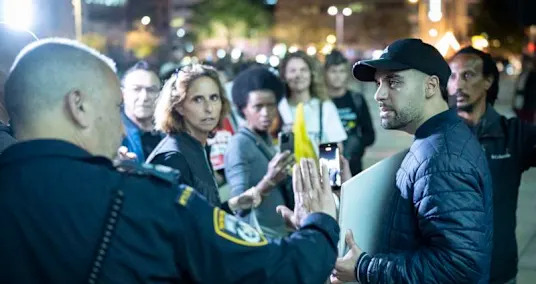
Protests took place in Tel Aviv, Jerusalem, Haifa, and Beersheba, as a survey found broad but uneven support among Jewish Israelis for Operation Roaring Lion.
Israel Police arrested 21 anti-war protesters Saturday night as demonstrations against the conflict with Iran expanded in multiple cities despite restrictions on public gatherings.
Protests took place in Tel Aviv, Jerusalem, Haifa, and Beersheba, with hundreds of participants reported in Tel Aviv and Jerusalem and about 100 in Haifa, marking the largest turnout since weekly demonstrations began. Authorities said 13 people were arrested in Tel Aviv and eight in Haifa.
Police said the gatherings were not approved under Home Front Command regulations that ban events with more than 50 people. Officials said the increase in turnout followed calls by groups opposing the government to protest despite the restrictions.
“During a situation assessment that took place at the scene with a Home Front Command representative… it was clarified that there was a real risk to human life and accordingly, Yarkon [precinct] police commander Tzachi Sharabi ordered the gathering to be dispersed,” police said.
Hadash-Ta’al chairman Ayman Odeh, an Arab lawmaker involved in the protests, criticized the police response, calling officers fascists “in the service of the government” and saying they were afraid of “the heroic citizens who went out, despite everything, to make their voice heard.”

Survey shows broad, uneven support for war
The demonstrations come as a March 2026 survey by the Israel Democracy Institute found broad but uneven support among Jewish Israelis for Operation Roaring Lion. Support was strongest on the Right at 87% and about half on the Left.
The survey also found that Jewish and Arab respondents largely agreed that Iran’s resilience has been stronger than expected. Most Jewish respondents said Israeli society could sustain the campaign for up to one month, while 28% said as long as needed. Arab respondents were less optimistic about how long the public could endure the conflict.
A majority of Jewish respondents said Prime Minister Benjamin Netanyahu’s decision was driven by security considerations, while most Arab respondents viewed it as political.
LATEST POSTS
- 1
 Israel halts defense sales to France, citing 'hostile attitude,' sources tell 'Post'
 - 2Tesla Stock Hasn’t Looked This Cheap in a While
- 3I'm 18 and founded an AI startup. I have to wake up at 3 a.m. to work on it before school, but it's worth every sleepless night.
- 4'The Beast in Me' arrives on Netflix: Is it based on a true story? And what drew Claire Danes to it? What to know about the thriller series.
- 5France to build new nuclear aircraft carrier, Macron says



- Ukraine proved this drone-killer works. Now, the West is giving it a shot.
- Well known SUVs With Low Energy Utilization In 2024
- In wrangling dark matter, some scientists find inspiration in the Torah, Krishna and Christ
- Former biotech CEO sued over COVID vaccine alleged insider trading
- Old video misrepresented as senior Sri Lankan ruling party member criticising president over fuel shortage
- Avoid Slam: Clearing the Street for the Eventual fate of Standard Size Trucks
- Dozens injured in Russia after train crashes, overturns
- 'No middle ground' for tackling antisemitism after Bondi Beach mass shooting, deputy FM Haskel says
- Best Disney Palace: Which One Catches Your Creative mind?